Friday, June 5, 2015

Dante 8

Charon and the Condemned Souls


CANTO III. The gate of Hell.--Virgil lends Dante in.--The
punishment of the neither good nor bad.--Aeheron, and the sinners
on its bank.--Charon.--Earthquake.--Dante swoons.

"Through me is the way into the woeful city; through me is the
way into eternal woe; through me is the way among the lost
people. Justice moved my lofty maker: the divine Power, the
supreme Wisdom and the primal Love made me. Before me were no
things created, unless eternal, and I eternal last. Leave every
hope, ye who enter!"

These words of color obscure I saw written at the top of a gate;
whereat I, "Master, their meaning is dire to me."

And he to me, like one who knew, "Here it behoves to leave every
fear; it behoves that all cowardice should here be dead. We have
come to the place where I have told thee that thou shalt see the
woeful people, who have lost the good of the understanding."

And when he had put his hand on mine, with a glad countenance,
wherefrom I took courage, he brought me within the secret things.
Here sighs, laments, and deep wailings were resounding though the
starless air; wherefore at first I wept thereat. Strange tongues,
horrible cries, words of woe, accents of anger, voices high and
hoarse, and sounds of hands with them, were making a tumult which
whirls forever in that air dark without change, like the sand
when the whirlwind breathes.

And I, who had my head girt with horror, said, "Master, what is
it that I hear? and what folk are they who seem in woe so
vanquished?"

And he to me, "This miserable measure the wretched souls maintain
of those who lived without infamy and without praise. Mingled are
they with that caitiff choir of the angels, who were not rebels,
nor were faithful to God, but were for themselves. The heavens
chased them out in order to be not less beautiful, nor doth the
depth of Hell receive them, because the damned would have some
glory from them."

And I, "Master, what is so grievous to them, that makes them
lament so bitterly?"

He answered, "I will tell thee very briefly. These have no hope
of death; and their blind life is so debased, that they are
envious of every other lot. Fame of them the world permitteth not
to be; mercy and justice disdain them. Let us not speak of them,
but do thou look and pass on."

And I, who was gazing, saw a banner, that whirling ran so swiftly
that it seemed to me to scorn all repose, and behind it came so
long a train of folk, that I could never have believed death had
undone so many. After I had distinguished some among them, I saw
and knew the shade of him who made, through cowardice, the great
refusal. [1] At once I understood and was certain, that this was
the sect of the caitiffs displeasing unto God, and unto his
enemies. These wretches, who never were alive, were naked, and
much stung by gad-flies and by wasps that were there. These
streaked their faces with blood, which, mingled with tears, was
harvested at their feet by loathsome worms.
*] Who is intended by these words is uncertain.


And when I gave myself to looking onward, I saw people on the
bank of a great river; wherefore I said, "Master, now grant to me
that I may know who these are, and what rule makes them appear so
ready to pass over, as I discern through the faint light." And he
to me, "The things will be clear to thee, when we shall set our
steps on the sad marge of Acheron." Then with eyes bashful and
cast down, fearing lest my speech had been irksome to him, far as
to the river I refrained from speaking.

And lo! coming toward us in a boat, an old man, white with
ancient hair, crying, "Woe to you, wicked souls! hope not ever to
see Heaven! I come to carry you to the other bank, into eternal
darkness, to heat and frost. And thou who art there, living soul,
depart from these that are dead." But when he saw that I did not
depart, he said, "By another way, by other ports thou shalt come
to the shore, not here, for passage; it behoves that a lighter
bark bear thee.
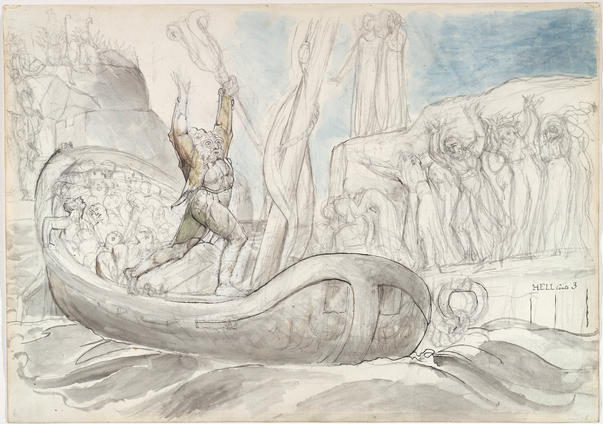

Charon and the Condemned Souls
Wiki commons William Blake Dante Plate 6


Thursday, June 4, 2015

8a


The River  Acheron
"In ancient Greek mythology, Acheron was known as the river of woe, and was one of the five rivers of the Greek underworld. In the Homeric poems the Acheron was described as a river of Hades, into which Cocytus and Phlegethon both flowed.

The Roman poet Virgil called it the principal river of Tartarus, from which the Styx and Cocytus both sprang.The newly dead would be ferried across the Acheron by Charon in order to enter the Underworld.

"Charon stands on the gunwale of the boat"
In Greek mythologyCharon or Kharon (/ˈkɛərɒn/ or /ˈkɛərən/;Greek Χάρων) is the ferryman of Hades who carries souls of the newly deceased across the rivers Styx and Acheron that divided the world of the living from the world of the dead. A coin to pay Charonfor passage, usually an obolus or danake, was sometimes placed in or on the mouth of a dead person.[1] Some authors say that those who could not pay the fee, or those whose bodies were left unburied, had to wander the shores for one hundred years.

"A lighter vessel must bear thee" implies that Dante (and/or) Virgil will escape Hell and perhaps make Purgatory.

Purgatory
"Purgatory, according to Catholic Church doctrine, is an intermediate state after physical death in which those destined for heaven "undergo purification, so as to achieve the holiness necessary to enter the joy of heaven".[ Only those who die in the state of grace but have not in life reached a sufficient level of holiness can be in Purgatory, and therefore no one in Purgatory will remain forever in that state or go to hell. This theological notion has ancient roots and is well-attested in early Christian literature, but the poetic conception of Purgatory as a geographically existing place is largely the creation of medieval Christian piety and imagination.

"Methodist churches hold that "the Romish doctrine concerning purgatory ... is a fond thing, vainly invented, and grounded upon no warrant of Scripture, but repugnant to the Word of God. Its founder John Wesley believed that there is "an intermediate state between death and the final judgment, where those who rejected Christ would be aware of their coming doom (not yet pronounced), and believers would share in the 'bosom of Abraham' or 'paradise', even continuing to grow in holiness there. Methodism does not formally affirm this belief, but maintains silence on what lies between death and the last judgment."

dante 7

 Vestibule of Hell

This from Illustrations from Dante:
In the Divine Comedy (Divina Commedia) Dante narrates the story of his journey out of the dark forest where he found himself in the middle of his life. With the Roman poet Virgil as guide he travels through Hell (Inferno) and Purgatory before finally reaching Paradise. The Inferno is described as a conical structure with successive circles, each reserved for particular categories of sinners. Purgatory is a mountain, on top of which is the Earthly Paradise where Dante finally meets his beloved Beatrice. Dante completed the Divine Comedy shortly before his death in 1321. It is one of the great texts of European culture and continues to inspire artists.

 water color Illustrations 

Blake's watercolour illustrations were commissioned in 1824 by John Linnell, friend and patron of his last years. They were executed at a time when Dante's masterpiece was being made more widely known through translation and critical re-evaluation. Henry Cary's first complete translation was published in 1814 and Blake owned a copy of it. He also taught himself Italian in order to be able to read the original. In the late 18th century the sublime and terrible passages of the Inferno were illustrated and singled out for praise, however, by the 1820s a new appreciation of the beauties of Purgatory, and especially Paradise, had emerged. Blake's originality as an illustrator of the Divine Comedy lies in his literary and visionary approach to the text. One of the ways he maintains a continuity of narrative throughout the series is by consistently showing Dante dressed in red (denoting experience) and Virgil in blue (denoting the spirit). Between 1824 and 1827, when he died, Blake completed 102 watercolours which survive in varying stages of completion. He intended to engrave the series - as Flaxman had done with his illustrations in the early 1800s - but managed to partially complete only seven plates.


Vestibule of Hell
Blake's Illustrations
wiki commo
Inferno: Canto III 

  All hope abandon, ye who enter in!"

These words in sombre colour I beheld
  Written upon the summit of a gate;
  Whence I: "Their sense is, Master, hard to me!"

And he to me, as one experienced:
  "Here all suspicion needs must be abandoned,
  All cowardice must needs be here extinct.

We to the place have come, where I have told thee
  Thou shalt behold the people dolorous
  Who have foregone the good of intellect."

And after he had laid his hand on mine
  With joyful mien, whence I was comforted,
  He led me in among the secret things.

There sighs, complaints, and ululations loud
  Resounded through the air without a star,
  Whence I, at the beginning, wept thereat.

Languages diverse, horrible dialects,
  Accents of anger, words of agony,
  And voices high and hoarse, with sound of hands,

Made up a tumult that goes whirling on
  For ever in that air for ever black,
  Even as the sand doth, when the whirlwind breathes.

And I, who had my head with horror bound,
  Said: "Master, what is this which now I hear?
  What folk is this, which seems by pain so vanquished?"

And he to me: "This miserable mode
  Maintain the melancholy souls of those
  Who lived withouten infamy or praise.

Commingled are they with that caitiff choir
  Of Angels, who have not rebellious been,
  Nor faithful were to God, but were for self.

The heavens expelled them, not to be less fair;
  Nor them the nethermore abyss receives,
  For glory none the damned would have from them."

And I: "O Master, what so grievous is
  To these, that maketh them lament so sore?"
  He answered: "I will tell thee very briefly.

These have no longer any hope of death;
  And this blind life of theirs is so debased,
  They envious are of every other fate.

No fame of them the world permits to be;
  Misericord and Justice both disdain them.
  Let us not speak of them, but look, and pass."

And I, who looked again, beheld a banner,
  Which, whirling round, ran on so rapidly,
  That of all pause it seemed to me indignant;

And after it there came so long a train
  Of people, that I ne'er would have believed
  That ever Death so many had undone.

When some among them I had recognised,
  I looked, and I beheld the shade of him
  Who made through cowardice the great refusal.

Forthwith I comprehended, and was certain,
  That this the sect was of the caitiff wretches
  Hateful to God and to his enemies.

These miscreants, who never were alive,
  Were naked, and were stung exceedingly
  By gadflies and by hornets that were there.

These did their faces irrigate with blood,
  Which, with their tears commingled, at their feet
  By the disgusting worms was gathered up.

And when to gazing farther I betook me.
  People I saw on a great river's bank;
  Whence said I: "Master, now vouchsafe to me,

That I may know who these are, and what law
  Makes them appear so ready to pass over,
  As I discern athwart the dusky light."

And he to me: "These things shall all be known
  To thee, as soon as we our footsteps stay
  Upon the dismal shore of Acheron."

Then with mine eyes ashamed and downward cast,
  Fearing my words might irksome be to him,
  From speech refrained I till we reached the river.

And lo! towards us coming in a boat
  An old man, hoary with the hair of eld,
  Crying: "Woe unto you, ye souls depraved!

Hope nevermore to look upon the heavens;
  I come to lead you to the other shore,
  To the eternal shades in heat and frost.

And thou, that yonder standest, living soul,
  Withdraw thee from these people, who are dead!"
  But when he saw that I did not withdraw,

He said: "By other ways, by other ports
  Thou to the shore shalt come, not here, for passage;
  A lighter vessel needs must carry thee."

And unto him the Guide: "Vex thee not, Charon;
  It is so willed there where is power to do
  That which is willed; and farther question not."

Thereat were quieted the fleecy cheeks
  Of him the ferryman of the livid fen,
  Who round about his eyes had wheels of flame.

But all those souls who weary were and naked
  Their colour changed and gnashed their teeth together,
  As soon as they had heard those cruel words.

God they blasphemed and their progenitors,
  The human race, the place, the time, the seed
  Of their engendering and of their birth!

Thereafter all together they drew back,
  Bitterly weeping, to the accursed shore,
  Which waiteth every man who fears not God.

Charon the demon, with the eyes of glede,
  Beckoning to them, collects them all together,
  Beats with his oar whoever lags behind.

As in the autumn-time the leaves fall off,
  First one and then another, till the branch
  Unto the earth surrenders all its spoils;

In similar wise the evil seed of Adam
  Throw themselves from that margin one by one,
  At signals, as a bird unto its lure.

So they depart across the dusky wave,
  And ere upon the other side they land,
  Again on this side a new troop assembles.

"My son," the courteous Master said to me,
  "All those who perish in the wrath of God
  Here meet together out of every land;

And ready are they to pass o'er the river,
  Because celestial Justice spurs them on,
  So that their fear is turned into desire.

This way there never passes a good soul;
  And hence if Charon doth complain of thee,
  Well mayst thou know now what his speech imports."

This being finished, all the dusk champaign
  Trembled so violently, that of that terror
  The recollection bathes me still with sweat.

The land of tears gave forth a blast of wind,
  And fulminated a vermilion light,
  Which overmastered in me every sense,

And as a man whom sleep hath seized I fell.

Monday, June 1, 2015

dante 6 good


Overview and vestibule of Hell[edit]

The poem starts on Maundy Thursday in the year 1300. The narrator, Dante himself, is thirty-five years old, and thus "halfway along our life's path" (Nel mezzo del cammin di nostra vita) – half of the Biblical lifespan of seventy (Psalms 89:10, Vulgate). The poet finds himself lost in a dark wood in front of a mountain, assailed by three beasts (a lion, a lonza [usually rendered as "leopard" or "leopon"],[2] and a she-wolf) he cannot evade. Unable to find the "straight way" (diritta via, also translatable as "right way") to salvation, he is conscious that he is ruining himself and falling into a "deep place" (basso loco) where the sun is silent (l sol tace).
Dante is at last rescued by the Roman poet Virgil, who claims to have been sent by Beatrice, and the two of them begin their journey to the underworld. Each sin's punishment in Inferno is a contrapasso, a symbolic instance of poetic justice; for example, fortune-tellers have to walk forward with their heads on backward, unable to see what is ahead, because they tried to see the future through forbidden means. Such a contrapasso "functions not merely as a form of divine revenge, but rather as the fulfilment of a destiny freely chosen by each soul during his or her life."[3]
Dante passes through the gate of Hell, which bears an inscription, the ninth (and final) line of which is the famous phrase "Lasciate ogne speranza, voi ch'intrate", or "Abandon all hope, ye who enter here."[4]
Before entering Hell completely, Dante and his guide see the Uncommitted, souls of people who in life did nothing, neither for good nor evil; among these Dante recognizes either Pope Celestine V or Pontius Pilate (the text is ambiguous). Mixed with them are outcasts who took no side in the Rebellion of Angels. These souls are neither in Hell nor out of it, but reside on the shores of the Acheron, their punishment to eternally pursue a banner (i.e. self interest) while pursued by wasps andhornets that continually sting them as maggots and other such insects drink their blood and tears. This symbolizes the sting of their conscience and the repugnance of sin. This can also be seen as a reflection of the spiritual stagnation they lived in. As with the Purgatorio and Paradiso, the Inferno has a structure of 9+1=10, with this "vestibule" different in nature from the nine circles of Hell, and separated from them by the Acheron.

From wiki:
Virgil is traditionally ranked as one of Rome's greatest poets. His Aeneid has been considered the national epic of ancient Rome from the time of its composition to the present day. Modeled after Homer's Iliad and Odyssey, theAeneid follows the Trojan refugee Aeneas as he struggles to fulfill his destiny and arrive on the shores of Italy—in Roman mythology the founding act of Rome. Virgil's work has had wide and deep influence on Western literature, most notably Dante's Divine Comedy, in which Virgil appears as Dante's guide through hell and purgatory.

The words of Dante:
"When I had journeyed half of our life's way, I found myself within a shadowed forest,
for I had lost the path that does not stray."

wiki common blake illustration of Dante's pictures
Inscriptions over Hell Gate

Abandon all hope, you who enter here (Canto III, line 9)
Often quoted with the translated form "Abandon hope all ye who enter here". The word "all" modifies hope, not those who enter: "ogni speranza" means "all hope".
Here must all distrust be left behind; all cowardice must be ended. (Canto III, lines14-15)

Words of Virgil:
'We are come to the place where I told thee; thou should see the wretched people, who have lost the good of the intellect.
And placing his hand on mine, with a cheerful countenace which comforted me he led me into the things that are hidden (Inferno III. 9-21)
The above taken from page 28 of Milton Klonsky's Blake's Dante.
This from wikiquote:
Their sighs, lamentations and loud wailings
resounded through the starless air,
so that at first it made me weep;
Strange utterances, horrible pronouncements,
words of pain, tones of anger,
voices shrill and faint, and beating hands,
all went to make a tumult that will whirl
forever through that turbid, timeless air,
like sand that eddies when a whirlwind swirls.

Sunday, May 31, 2015

Dante 5


In Songs of Experience Blake introduced the 'forest';

TIGER, tiger, burning bright
In the forests of the night,

Through the years of his career he used 'forest often; it occurred 63 times in his poetry.
In his last years he turned to the poetry of Dante and found his 'forest' and put it in one of his
Illustrations.


Dante and Virgil Penetrat the Forest
Blake's Illustration
Wiki Common


Saturday, April 4, 2015

faith 1


Faith

Thursday 9 Dec. 2010

HOME

CHAPTER FOUR

Faith

Everything that lives is holy (end of MHH)
"...I rest not from my great task!
To open the Eternal Worlds, to open the immortal Eyes Of Man inwards into the Worlds of Thought, into Eternity
Ever expanding in the Bosom of God, the Human Imagination."
(Jerusalem Plate 5: line 17ff)
    Seek love in the pity of another's woe,
    In the gentle relief of another's care,
    In the darkness of night and the winter's snow.
    In the naked and outcast, seek love there. (William Bond)
The most striking tenet of Blake's faith was his vision of the Eternal; it was also his primary gift to mankind. Blake lived in an age when the realm of spirit had virtually disappeared from the intellectual horizon. This single fact explains why he stood out like a sore thumb in late 18th Century England and why for most of his contemporaries he could never be more than an irritant, an eccentric, a madman; their most common term of depreciation was 'enthusiast'. His primary concern was a world whose existence they not only denied, but held in derision.
The task of the Enlightenment had been to emancipate man from superstition, and Voltaire, Gibbon, and their associates had done this with great distinction. Blake was born emancipated, but he knew that closed off from Vision, from the individuality of Genius, from the spontaneous spiritual dimension, from what Jesus had called the kingdom of God, mankind will regress to a level beneath the human. In his prophetic writings he predicted 1940 and its aftermath. "Where there is no vision, the people perish" (Proverbs 29:19).
Blake was blessed with vision from his earliest days; his visions were immediate and concrete. He found the eternal inward worlds of thought more real than the objective nature exalted by John Locke and Joshua Reynolds. Their depreciation of vision, genius, the Eternal never failed to infuriate Blake. This fury strongly colored his work and often threatened to overwhelm it. It also led to his deprecatory view of Nature, which was their God. He wrote, "There is no natural religion".
Blake perceived the five senses as "the chief inlets of Soul in this age" (MHH plate 4). The rationalists had imposed upon their world the view that life consists exclusively of the five senses. Blake knew better:
"How do you know but ev'ry Bird that cuts the airy way, Is an immense world of delight, clos'd by your senses five?" (MHH plate 7)
Blake was keenly alive to another world, a world of Vision, of Imagination, of God, which he called the Eternal; it was a world that most of his contemporaries had deliberately closed their minds to. He spent his life furiously trying to strike off their mind forged manacles.
The man of faith believes some things; other things he knows by experience. Blake had experienced the Eternal from earliest childhood. At times the vision clouded, but its reality remained the one unshakeable tenet of his faith.
Every child begins in Eternity. Jesus said, "Except you become as little children...."
Blake knew this better than anyone since Jesus, or maybe anyone since Francis. He knew it because by a providential dispensation of grace the child in Blake remained alive throughout his life. At the age of 34 he wrote those beautiful 'Songs of Innocence', his "happy songs Every child may joy to hear". 'Songs of Innocence' hooked a great many people on Blake originally: transparent goodness transcribed into black type on white paper--somewhat beyond Locke's tabula rasa.
If life were only like that. If Blake were only like that, he'd have an assured place as one of England's best loved poets, a beloved impractical idealist and a threat to no one. But in 'Songs of Experience' he began to express a more complex reality. 'The Marriage of Heaven and Hell' represents a healthy beginning in working out the complexities. They have to be worked out, every minute particular in the corrosive burning flame of thought, etching away the surfaces, getting down to bedrock.
Most of us have refused Blake and his Eternal because we don't want to be bothered with reality; we don't want to take the trouble. We're content with the little sub-realities that inform our lives and values, the simple half truths and prejudices which we call the real world.
       Blake wrote, etched, painted, sang his visions of Eternity throughout a long life time. This chapter systematizes his visions as they address and relate to the general constructs of Christian theology. That enterprise of course violates the spirit of his creative genius, which refused systematization. Nevertheless we systematize in the hope that a coherent picture of his faith may emerge and lead the faithful reader to an encounter with the original, organized in Blake's own inimitable style.

i

God

    that they may be one, even as we are one: I in them
    and thou in me, that they may be made perfect in one.
    (John 17)

       The theologues of the forties and fifties learned from Paul Tillich that everyone has an ultimate concern, his God. People in Alcoholics Anonymous have told some of their theologically confused members that, lacking any better God, they may worship a 'pot on the mantle', anything at all to break that devotion to the bottle which is actually the worship of a lower form of the self. To remain sober one must believe in a Higher Power of some sort.
       The important thing is that one's Higher Power be not a projection of some lower form of self; that's idolatry. The person seriously interested in ultimate reality engages in a life long search for the most real image he can discover, the image of his God. A person's best image of God nurtures his spirit as he goes through life.
       The Bible contains a multiplicity of images of God. For example we read about the finger of God, the nostrils of God, even the backside of God. All his life Blake maintained a high level of respect for the Bible as vision. Nevertheless he refused to worship other men's visions of God:
I (you!) must create a system, or be enslaved by another man's (Jerusalem, 10.21; E153)".
He's saying that we have a choice: to adhere to the conventions (whatever conventions may be for us) or to create our own values from our own experience. Blake did this for a lifetime, creating his own myth of meaning, and with his creative works he expressed it over and over again.
       The only thing Blake really trusted was his own immediate direct vision, and he possessed his soul in varying degrees of patience until that vision clarified (and you may be sure that it was criticized, corrected and amended over and over again. The
'Felpham Moment' marks the decisive clarification of Blake's vision of God. Even then the Father remained for Blake a symbol of subjection to the other man's vision, of spiritual tyranny. His own vision came to center upon Jesus.
       Nobodaddy, Father of Jealousy, Urizen, all the creator and authority figures that filled the young Blake's mind, represented in essence his rejection of other men's images of God. The "Vision of Ahania" (4Z: chapter 3, 39.13ff; E327) expressed Blake's dawning awareness of a fundamental spiritual truth: the transcendental image which had dominated institutional religion is most often a projection of man's primitive negativities. The ultimate negativities, repressed into the unconscious, irupt into consciousness as the ultimate positivity, a God built upon sand, a "shadow from his wearied intellect". This passage, probably as much as anything else in his experience, inspired Thomas Altizer in the sixties to launch his Death of God movement.
       Blake depreciated the God of Law and Wrath in order to exalt the God of Forgiveness. He believed that the far off, elusive, mysterious, transcendental image of God freezes man into spiritual immobility. He wanted to liberate men's minds from this imposture and put them in touch with the true source of creativity:
    "Seek not thy heavenly father then beyond the skies,
    There Chaos dwells & ancient Night & Og & Anak old. " (Milton 20:33-34)

    I am not a God afar off, I am a brother and friend;
    Within your bosoms I reside, and you reside in me:
    Lo! we are One, forgiving all Evil, Not seeking recompense.
    Ye are my members....
           (Jerusalem 4:18-21)
       The prophetic poems which Blake wrote prior to 1800 concern his efforts to know, describe and deal with the old, jealous, wrathful, creator image; he finally dismissed it as a "shadow from his wearied intellect" (FZ3-40.3). The later, major prophecies, Milton and Jerusalem, also contain this theme, happily outweighed by the new vision.
Prior to the Felpham Moment Blake had worshipped his own visionary endowment, his Pot on the Mantle; he called it the Poetic Genius and later the Imagination.

The evolving figure of Los building Golgonooza personified what we might call a pre-Christian God. When grace fell upon Blake, he came to see the true embodiment of God in Jesus.
       In a letter to his friend and patron, Thomas Butts, he described the experience of redemption that had come to him:
       "And now let me finish with assuring you that tho I have been very unhappy I am so no longer I am again Emerged into the light of Day I still & shall to Eternity Embrace Christianity and Adore him who is the Express image of God..."
       The last part of CHAPTER FIVE contains a detailed description of Jesus as the mature Blake envisioned him. At this point we look again at the lovely poem Blake wrote to Butts in October, 1800 reporting on an early appearance of Jesus to him, perhaps the first--when he was 43. He aptly called it "My first Vision of Light":

    To my Friend Butts I write My first Vision of Light, On the yellow sands sitting. The Sun was Emitting His Glorious beams From Heaven's high Streams. Over Sea, over Land My Eyes did Expand Into regions of air Away from all Care, Into regions of fire Remote from Desire; The Light of the Morning Heaven's Mountains adorning: In particles bright The jewels of Light Distinct shone & clear. Amaz'd & in fear I each particle gazed, Astonish'd, Amazed; For each was a Man Human-form'd..... I stood in the Streams Of Heaven's bright beams, And Saw Felpham sweet Beneath my bright feet In soft Female charms; And in her fair arms My Shadow I knew And my wife's shadow too And my sister & Friend. We like Infants descend In our Shadows on Earth Like a weak mortal birth. My Eyes more & more Like a Sea without shore Continue Expanding, The Heavens commanding, Till the Jewels of Light, Heavenly Men beaming bright, Appear'd as One Man Who Complacent began My limbs to infold In his beams of bright gold; Like dross purg'd away All my mire & my clay. Soft consum'd in delight In his bosom Sun bright I remain'd. Soft he smil'd And I heard his voice Mild Saying: This is My Fold, O thou Ram horn'd with gold! And the voice faded mild.

Friday, April 3, 2015

The Bible and Blake 1

The Bible and Blake

 Little Black Boy
                                                 from Songs of Innocence


Blake with his unusually high intelligence can be assumed to have to have learned to read very early in his life. Very likely the Bible.
Very likely the Bible was among his preferred reading material. He seems to have been attracted to the Old Testament prophets such as Isaiah, Ezekiel, Jeremiah, Amos whose influence is seen in his poetry.
It is interesting to think of Blake as a young child reading the Bible without instruction or supervision, as interacting in his own unique, superintelligent way. He got into some scholarship later and also absorbed the general understanding from his culture. Nevertheless his interaction and interpretation continued to be direct and unusual.
                                                                 
Annotations to Berkeley, (E 664)
"Jesus supposes every Thing to be Evident to the Child & to
the Poor & Unlearned Such is the Gospel
The Whole Bible is filld with Imaginations & Visions from
End to End & not with Moral virtues that is the baseness of Plato
& the Greeks & all Warriors The Moral Virtues are continual
Accusers of Sin & promote Eternal Wars & Domineering over others"
Annotations to Berkeley, (E 664)
"Man is All Imagination God is Man & exists in us & we in him"

Jonathan Roberts and Christopher Rowland contributed a chapter to theBlackwell Companion to the Bible in English Literature in which they present their views on Blake's use of the Bible (Page 376):
"This emphasis on the importance of individuals (and their social contexts) in interpreting the Bible means that Blake is particularly concerned with replacing a literalist hermeneutic with one that considers the Bible to be a stimulus to the imagination. This means above all engaging readers in the interpretation of the text, rather than demanding they accept it as in object above and beyond them. To this end Blake provides a consistent polemic against the preoccupation with the literal sense of the text, and against a reverence for the text that comes at the expense of what an imaginative and life-affirming encounter with the Bible might offer. These two tasks required a thoroughgoing assault on the ways in which the Bible had been constructed and reduced to a focus on the sacrificial death of Jesus and a religion of moral virtue. Blake would have no truck, for example, with the view that humans are inherently sinful: that God must be appeased by a sacrifice (of Christ); and that God - having made that sacrifice - then expects humanity to behave morally in order to stay in relationship with him (i.e. by keeping his commandments). Such an outlook, Blake thought, led to a denial of aspects of the human person and the subjection of some human beings to others."

Blake seemed to continue to read the Bible as he had as a child - with an open mind. He didn't look back to what the words had meant when they were written exclusively, but to what they meant in the immediate present to his own imaginative ability. His conversations with Ezekiel and Isaiah may have begun long before he wrote The Marriage of Heaven and Hell and continued long after.