Friday, October 18, 2013

Europe 6


Wikipedia Commons
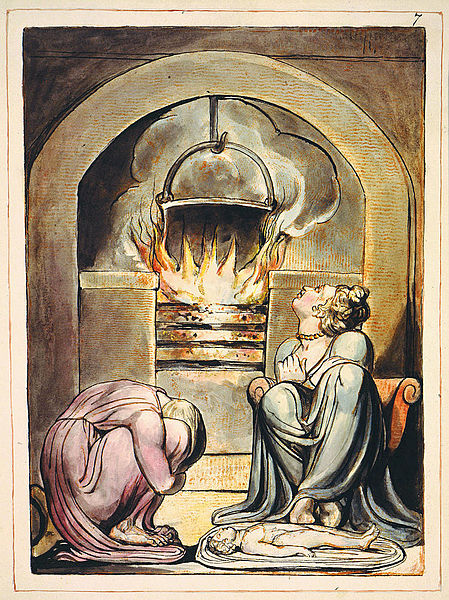
Europe Plate 6

A lurid scene at the bottom, of a child dead, presumably of starvation.  At the top a pot over a flaming fire-- to cook the child?
This is something of the consequence that Blake sees from Enitharmon's intention: WAR.

Two women under the furnace:
   The one on the left bent over with grief.
   The other one, sitting on a sort of throne with an infant, contemplating the pot.
Gruesome!

Blake was familiar with the story in Ist Kings 3 commonly called "splitting the baby"
"[16] Then came there two women, that were harlots, unto the king, and stood before him.
[17] And the one woman said, O my lord, I and this woman dwell in one house; and I was delivered of a child with her in the house.
[18] And it came to pass the third day after that I was delivered, that this woman was delivered also: and we were together; there was no stranger with us in the house, save we two in the house.
[19] And this woman's child died in the night; because she overlaid it.
[20] And she arose at midnight, and took my son from beside me, while thine handmaid slept, and laid it in her bosom, and laid her dead child in my bosom.
[21] And when I rose in the morning to give my child suck, behold, it was dead: but when I had considered it in the morning, behold, it was not my son, which I did bear.
[22] And the other woman said, Nay; but the living is my son, and the dead is thy son. And this said, No; but the dead is thy son, and the living is my son. Thus they spake before the king.
[23] Then said the king, The one saith, This is my son that liveth, and thy son is the dead: and the other saith, Nay; but thy son is the dead, and my son is the living.
[24] And the king said, Bring me a sword. And they brought a sword before the king.
[25] And the king said, Divide the living child in two, and give half to the one, and half to the other.

Tuesday, October 8, 2013

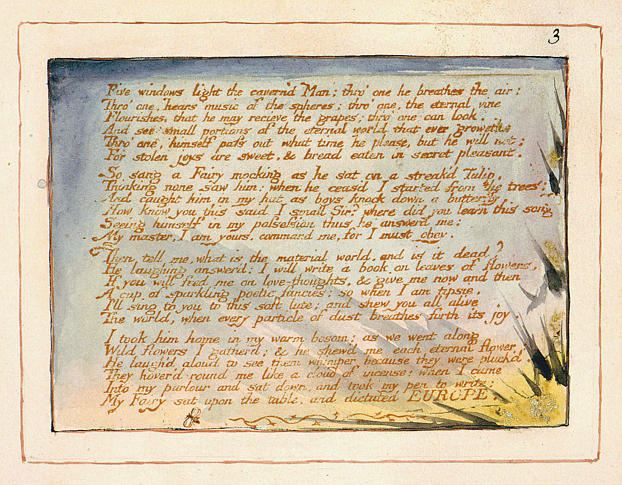
Europe A Prophecy iii A Preface

Here is an earlier post on 'Five Windows'.

Wikipedia Commons
Plate iii of
Europe a Prophecy

EUROPE a PROPHECY
So sang a Fairy mocking as he sat on a streak'd Tulip,


This Plate appears only in Copy K of Blake Archive.

Thro' one, himself pass out what time he please, but he will not;
For stolen joys are sweet, & bread eaten in secret pleasant.

LAMBETH Printed by Will: Blake 1794
PLATE iii
Five windows light the cavern'd Man; thro' one he breathes the air;
Thro' one, hears music of the spheres; thro' one, the eternal vine
Flourishes, that he may recieve the grapes; thro' one can look.
And see small portions of the eternal world that ever groweth;
Thinking none saw him: when he ceas'd I started from the trees!
And caught him in my hat as boys knock down a butterfly
How know you this said I small Sir? where did you learn this song
Seeing himself in my possession thus he answerd me:
My master, I am yours. command me, for I must obey.
Then tell me, what is the material world, and is it dead?
He laughing answer'd: I will write a book on leaves of flowers,
If you will feed me on love-thoughts, & give me now and then
A cup of sparkling poetic fancies; so when I am tipsie,
I'll sing to you to this soft lute; and shew you all alive
The world, where every particle of dust breathes forth its joy.
I took him home in my warm bosom: as we went along
Wild flowers I gatherd; & he shew'd me each eternal flower:
He laugh'd aloud to see them whimper because they were pluck'd.
They hover'd round me like a cloud of incense: when I came
Into my parlour and sat down, and took my pen to write:
My Fairy sat upon the table, and dictated EUROPE.
(Erdman 58-9)


So sang a Fairy mocking as he sat on a streak'd Tulip,
In a picturesque way Blake introduces these visions.
My Fairy sat upon the table, and dictated EUROPE.
Five windows light the cavern'd Man

Look at this from MHH plate 4:

Man has no Body distinct from his Soul for that calld Body is
a portion of Soul discernd by the five Senses. the chief inlets
of Soul in this age.

Look at this from the First Book of Urizen:
Urizen was Blake's creator. This is an account of his Creation.
8. In harrowing fear rolling round;                    
His nervous brain shot branches
Round the branches of his heart.
On high into two little orbs
And fixed in two little eaves
Hiding carefully from the wind,                         
His Eyes beheld the deep,
And a third Age passed over:
And a state of dismal woe.

9. The pangs of hope began,
In heavy pain striving, struggling.      
Two Ears in close volutions.
From beneath his orbs of vision
Shot spiring out and petrified
As they grew. And a fourth Age passed
And a state of dismal woe.          

10. In ghastly torment sick;
Hanging upon the wind;

PLATE 13
Two Nostrils bent down to the deep.
And a fifth Age passed over;
And a state of dismal woe.

11. In ghastly torment sick;
Within his ribs bloated round,         
A craving Hungry Cavern;
Thence arose his channeld Throat,
And like a red flame a Tongue
Of thirst & of hunger appeard.
And a sixth Age passed over:          
And a state of dismal woe.
 
12. Enraged & stifled with torment
He threw his right Arm to the north
His left Arm to the south
Shooting out in anguish deep,           
And his Feet stampd the nether Abyss
In trembling & howling & dismay.
And a seventh Age passed over:
And a state of dismal woe.
(Erdman 76)


Monday, October 7, 2013

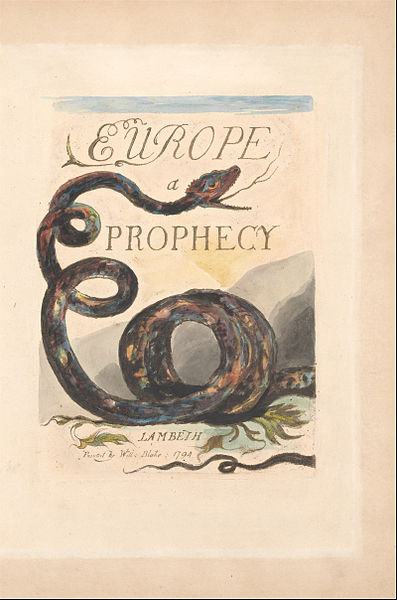
Europe a Prophecy ii Title Page


Rosenwald LC
Title Page
Of these two images which do you find most clear?

Commons Wikipedia
Plate ii Title page

At the bottom of the picture Blake has put:
Lambeth
Printed by Will: Blake: 1794
There's no other text.

About the Image

The item of most interest of course is the snake
Erdman Illuminated p.157:
Note how the tail leaves the image and comes back below the signature.
Erdman refers us to his book, Blake Prophet Against Empire, Chapters 9 and 12.

The Blake Archive has 7 copies of this Plate:
Copy B in Glasgow University Library shows two mountains in the lower part of the Plate.
The higher one may be in the sun, the lower one in shade.
The serpent's tail comes back in below the inscription.

Copy D in the British Museum is much the same.

Notice the crest at the top of the serpent's head, the long, protruding tongue is forked.
The serpent is Orc  a positive figure, the embodiment of rebellion, and stands opposed to Urizen, the embodiment of tradition (from wikipedia).


Here are the known copies:
All Known Copies (from Blake Archive
  • opy a (proofs), 1794
    British Museum, Dept. of Prints and Drawings
    London
  • Copy C, 1794
    Houghton Library
    Harvard University, Cambridge, Massachusetts
  • Copy D, 1794
    British Museum, Dept. of Prints and Drawings
    London
  • Copy E, 1794
    Rosenwald Collection, Library of Congress
    Washington D.C.
  • Copy F, 1794
    Berg Collection, New York Public Library
    New York City
  • Copy A, 1795
    Yale Center for British Art
    Yale University, New Haven, Connecticut
  • Copy H, 1795
    Houghton Library
    Harvard University, Cambridge, Massachusetts
  • Copy I, c. 1832
    Auckland Public Library
    Auckland, New Zealand
  • Copy L, c. 1832
    Huntington Library and Art Gallery
    San Marino, California
  • Copy M, c. 1832
    Fitzwilliam Museum
    Cambridge, England

Saturday, October 5, 2013

Europe ii Title Page


Rosenwald LC
Title Page
Of these two images which do you find most clear?

Commons Wikipedia
Plate ii Title page

At the bottom of the picture Blake has put:
Lambeth
Printed by Will: Blake: 1794
There's no other text.

About the Image

The item of most interest of course is the snake
Erdman Illuminated p.157:
Note how the tail leaves the image and comes back below the signature.
Erdman refers us to his book, Blake Prophet Against Empire, Chapters 9 and 12.

The Blake Archive has 7 copies of this Plate:
Copy B in Glasgow University Library shows two mountains in the lower part of the Plate.
The higher one may be in the sun, the lower one in shade.
The serpent's tail comes back in below the inscription.

Copy D in the British Museum is much the same.

Notice the crest at the top of the serpent's head, the long, protruding tongue is forked.
The serpent is Orc  a positive figure, the embodiment of rebellion, and stands opposed to Urizen, the embodiment of tradition (from wikipedia).


Here are the known copies:
All Known Copies (from Blake Archive
  • opy a (proofs), 1794
    British Museum, Dept. of Prints and Drawings
    London
  • Copy C, 1794
    Houghton Library
    Harvard University, Cambridge, Massachusetts
  • Copy D, 1794
    British Museum, Dept. of Prints and Drawings
    London
  • Copy E, 1794
    Rosenwald Collection, Library of Congress
    Washington D.C.
  • Copy F, 1794
    Berg Collection, New York Public Library
    New York City
  • Copy A, 1795
    Yale Center for British Art
    Yale University, New Haven, Connecticut
  • Copy H, 1795
    Houghton Library
    Harvard University, Cambridge, Massachusetts
  • Copy I, c. 1832
    Auckland Public Library
    Auckland, New Zealand
  • Copy L, c. 1832
    Huntington Library and Art Gallery
    San Marino, California
  • Copy M, c. 1832
    Fitzwilliam Museum
    Cambridge, England

Thursday, October 3, 2013

Europe the Prophecy Frontspiece


Commons wikipedia.org
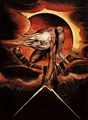
Ancient of Days
Blake found the Ancient of Days as a name for God. 
God was referred to as the Ancient of Days three times in the 9th Chapter of the  Book of Daniel. Here is one of them:
"[9] I beheld till the thrones were cast down, and the Ancient of days did sit, whose garment was white as snow, and the hair of his head like the pure wool: his throne was like the fiery flame, and his wheels as burning fire.
[10] A fiery stream issued and came forth from before him: thousand thousands ministered unto him, and ten thousand times ten thousand stood before him: the judgment was set, and the books were opened.

But Blake wasn't the only artist who used the 9th Chapter of Daniel; John of Patmos, the writer of the Book of Revelation did also, sometimes almost verbatim.

From Wikipedia: 
"When Europe was printed, it was in the same format as Blake's America and sold for the same price. It was printed between 1794 and 1821 with only 9 copies of the work surviving.."
and seven in the Blake Archive.

It was said to be used as "a portrait of Urizen in his finest hour" (Erdman Illuminated p.155).
This reminds us that Blake thought of the Old Testmant (non-forgiving) God as noted for 'the
bump on the head'

Wednesday, October 2, 2013

Song of Los Frontspiece and Title


The Song of Los: Frontspiece
There is no text for this Plate (1A)

The knelling (prayerful?) figure, thought to be Urizen
bows before a cloudy Sun.

Blake Archive has copies A through E, each one said to be presenting the 'Sun' in a different way.

Go to Copy A from the British Museum.
Then Copy B. from the Library of Congress.
Then Copy C from the Morgan Library and Museum.
Then Copy D from the Britiish Museum. 
Then Copy E. from the Henry E. Huntington Library and Art Gallery.

The white haired figure may be thought of as Urizen or a priest who represents false religion.


Title Page

THE SONG of LOS
LAMBETH Printed by W Blake 1795

Tuesday, October 1, 2013

intro

Early in our study of Blake's blog I was studying Revelation.

Here's a portion of Chapter 1 of Revelation:
"[12] And I turned to see the voice that spake with me. And being turned, I saw seven golden candlesticks;
[13] And in the midst of the seven candlesticks one like unto the Son of man, clothed with a garment down to the foot, and girt about the paps with a golden girdle.
[14] His head and his hairs were white like wool, as white as snow; and his eyes were as a flame of fire;
[15] And his feet like unto fine brass, as if they burned in a furnace; and his voice as the sound of many waters.
[16] And he had in his right hand seven stars: and out of his mouth went a sharp twoedged sword: and his countenance was as the sun shineth in his strength.
[17] And when I saw him, I fell at his feet as dead. And he laid his right hand upon me, saying unto me, Fear not; I am the first and the last:
[18] I am he that liveth, and was dead; and, behold, I am alive for evermore, Amen; and have the keys of hell and of death.
[19] Write the things which thou hast seen, and the things which are, and the things which shall be hereafter;
[20] The mystery of the seven stars which thou sawest in my right hand, and the seven golden candlesticks. The seven stars are the angels of the seven churches: and the seven candlesticks which thou sawest are the seven churches.
Something clicked: what did Blake do with the golden bowl? In the beginning of Thel we read:

Does the Eagle know what is in the pit?
Or wilt thou go ask the Mole:
Can Wisdom be put in a silver rod?
Or Love in a golden bowl?


In Thel we're introduced to the Lilly, in fact the Lilly of the Valley, a name for Christ; the Bible also uses the lamb for that purpose, in Rev 5 in fact. So Blake took the lamb and the golden bowl from Rev 5:

([8] And when he had taken the book, the four beasts and four and twenty elders fell down before the Lamb, having every one of them harps, and golden vials full of odours, which are the prayers of saints.)

 and used it to set the stage for Thel, one of his earliest lessons for us from the Bible.

Move now down to Blake's first vision of light, and note the identity that God (Christ) gave to him:

Thou ram horn'd with gold. You might say we're still in Rev 5.

(For more on this go here.)